Excursion to Garni, Geghard and "Symphony of Stones"
|
Duration: 4hrs
|
Price without guide
|
Price with guide
|
| Car (max. 3 passengers) | 30 000 AMD | 50 000 AMD |
| Minivan (max. 7 passengers) | 40 000 AMD | 60 000 AMD |
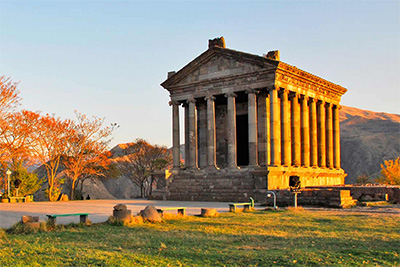
The pagan temple of Garni is supposed to be built in 77 AD. It is located in Kotayk region of Armenia at the left bank of Azat River. The temple was dedicated to God Mihr, the Armenian pagan god of light and the Sun.
According to a Greek inscription, it was founded by Tiridates I of Armenia. In 305 when Armenian King Tiridates III adopted Christianity as a state religion, all the pagan places of worship were destroyed. The Temple of Garni is the only pagan Hellenistic and Greco-Roman structure to have survived. Probably it survived because of its widely recognised status of "masterpiece of art".
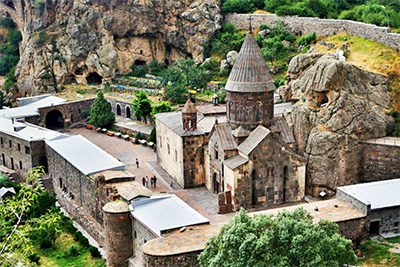 Armenia is famous among tourists for the variety of its monasteries and religious monuments, but the most famous of them is Gegard Monastery or Gegardavank.
Both tourists and locals love Geghard because the view is simply incredible: the monastery is located in a gorge between high suspended rocks, between mountains covered with thick forests. The monastery itself and its cells are carved into the rock.
The monuments included in the complex date to the IV-XIII centuries. Previously, the monastery was called Ayrivank (cave monastery). According to history, the monastery was founded by St. Gregory the Illuminator and was built after the adoption of Christianity as the state religion in Armenia in 301.
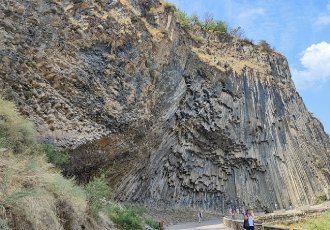
The Symphony of Stones, also known as the Basalt Organ, is one of Armenia’s most impressive natural monuments. It is located in the Garni Gorge, on the right bank of the Azat River.
The monument consists of thousands of basalt columns reaching up to 50 meters in height. Their distinctive shape resembles the pipes of a musical organ, which is why the site is officially called the Basalt Organ, although it is more commonly known as the Symphony of Stones.
The rock formation is volcanic in origin. Around 127,000 years ago, a powerful eruption occurred in the Geghama Mountains, sending lava into the surrounding area. As the lava slowly cooled, it formed the characteristic pentagonal and hexagonal basalt columns we see today.